
Analytics & Real-Time Data
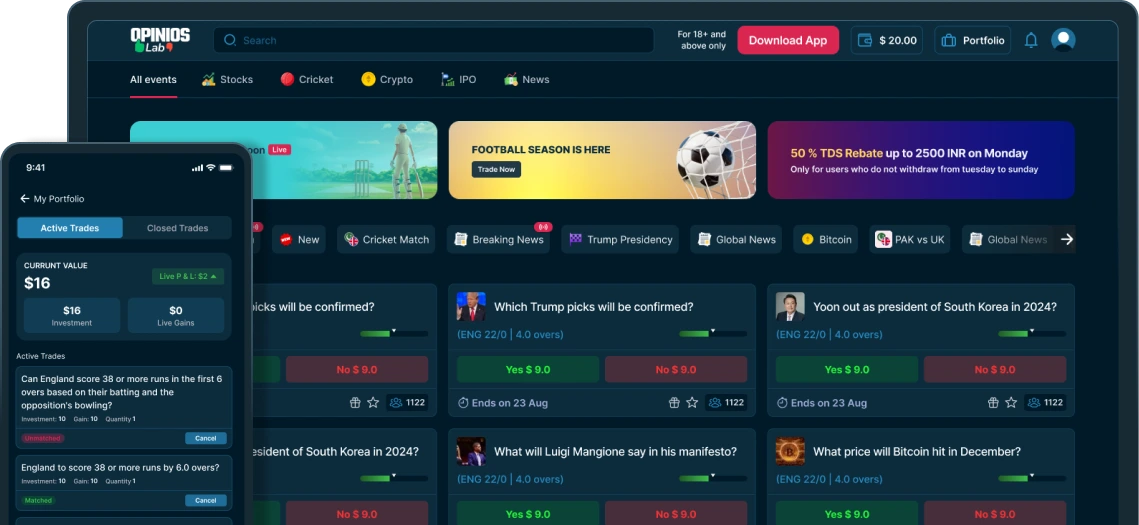
Access real-time data, track trends, and monitor performance instantly.



Ready to launch your prediction market platform? Opinios Lab is the leading prediction market platform development company, offering secure, customizable, and user-friendly app solutions backed by years of expertise.
Global Market Growth By 2024
Predicted Global Market Growth By 2032
Access real-time data, track trends, and monitor performance instantly.
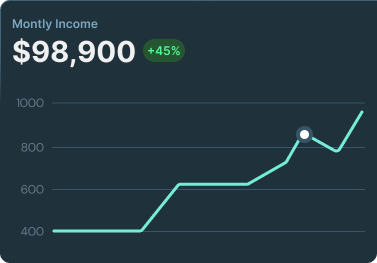

Secure payment options, easy fund management ensure smooth transactions for every user
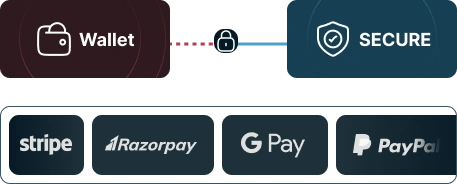

Access real-time data, track trends, and monitor performance instantly.


It creates an interactive feed where users can upvote, comment, and share insights.
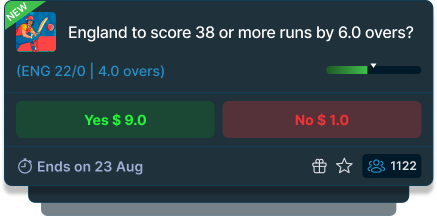

Access real-time data, track trends, and monitor performance instantly.


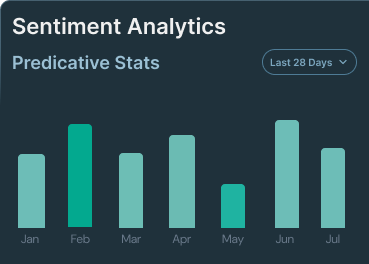
Unlock powerful insights with AI-driven analytics!
We at Opinios Lab, a Top Prediction market platform development company is dedicated to providing outstanding prediction marketplace platform development. Our team of expert developers aims to turn your mission into reality & reach your business goals.

We understand our client's requirements and offer a personalized platform that meets their business goals.

Our development provides an intuitive navigation with real-time interactions that increase user engagement.

The platform we develop has the potential to handle large volumes of data seamlessly with high performance.

Right from analysis to deployment and ongoing updates our support team helps to run your app smoothly.












 YouTube
 Crypto
 Stocks
 Soccer
YouTube
Crypto
Stocks
Soccer
Soccer
YouTube
Crypto
Stocks
Soccer
 IPO
IPO
 General Trading
 News
IPO
General Trading
News
News
IPO
General Trading
News
What Our Customer Says About Us
Highly recommend Opinios Lab for predictive marketplace platform development. Their team is highly skilled and completed my project ahead of the provided timeline.

We selected Opinios Lab to develop our predictive marketplace platform. Their team was exceptional, providing valuable guidance throughout the development process until its completion.

We partnered with the Opinios Lab team for our predictive marketplace platform development. From scoping to end-to-end development and post-launch support, their services were exceptionally top-notch. Highly recommended!

Opinios Lab transformed our vision into reality with their predictive marketplace platform development services. Their expertise and seamless execution exceeded our expectations. Highly recommended!

From concept to execution, Opinios Lab impressed us with their predictive marketplace development services. Their technical expertise is a class apart. Highly efficient team!

The Opinios Lab team truly cared about helping us succeed. They developed a predictive marketplace platform that not only meets our needs but also delights our users.

Highly recommend Opinios Lab for predictive marketplace platform development. Their team is highly skilled and completed my project ahead of the provided timeline.
We selected Opinios Lab to develop our predictive marketplace platform. Their team was exceptional, providing valuable guidance throughout the development process until its completion.
We partnered with the Opinios Lab team for our predictive marketplace platform development. From scoping to end-to-end development and post-launch support, their services were exceptionally top-notch. Highly recommended!
Opinios Lab transformed our vision into reality with their predictive marketplace platform development services. Their expertise and seamless execution exceeded our expectations. Highly recommended!
From concept to execution, Opinios Lab impressed us with their predictive marketplace development services. Their technical expertise is a class apart. Highly efficient team!
The Opinios Lab team truly cared about helping us succeed. They developed a predictive marketplace platform that not only meets our needs but also delights our users.
Working with Opinios Lab felt like a partnership. They cared about our vision and built a predictive marketplace platform that serves our business and customers perfectly.

We felt supported every step of the way with Opinios Lab. They listened to our needs and developed a predictive marketplace solution that exceeded our expectations.

We approached Opinios Lab a Best Prediction marketplace platform development company with a vision, and they brought it to life. Their dedication towards our project made us feel confident throughout the journey.

We felt supported at every stage with Opinios Lab. They listened, adapted, and delivered a predictive marketplace platform that truly helps us thrive in a competitive market.

Highly recommended team for developing predictive marketplace platforms! The Opinios Lab team has in-depth expertise and a thorough understanding of building predictive marketplace solutions.

Opinios Lab was highly efficient and skillful in developing our predictive marketplace platform. They assigned a dedicated project manager who guided us seamlessly through the entire development process.

Working with Opinios Lab felt like a partnership. They cared about our vision and built a predictive marketplace platform that serves our business and customers perfectly.
We felt supported every step of the way with Opinios Lab. They listened to our needs and developed a predictive marketplace solution that exceeded our expectations.
We approached Opinios Lab a Best Prediction marketplace platform development company with a vision, and they brought it to life. Their dedication towards our project made us feel confident throughout the journey.
We felt supported at every stage with Opinios Lab. They listened, adapted, and delivered a predictive marketplace platform that truly helps us thrive in a competitive market.
Highly recommended team for developing predictive marketplace platforms! The Opinios Lab team has in-depth expertise and a thorough understanding of building predictive marketplace solutions.
Opinios Lab was highly efficient and skillful in developing our predictive marketplace platform. They assigned a dedicated project manager who guided us seamlessly through the entire development process.
Our Latest Blogs

You open a sports app. You do not bet against a house. You trade against other fans. The price moves in real time, just like a stock. That is the idea behind Onyx Odds, and you can build your own version faster than you think. Prediction markets are having a breakout moment. Combined monthly volume on the two biggest platforms jumped from under 5 billion dollars in September 2025 to about 24 billion dollars by April 2026. Founders who move now can ride that wave. Here is the good news. With a specialist prediction market platform development company like Opinios Labs, you can go live in about 60 days. This guide walks you through the market, the features, the tech stack, the cost, the timeline, and the rules you must follow. By the end, you will know how to create a prediction market platform like Onyx Odds.

6th October 2026

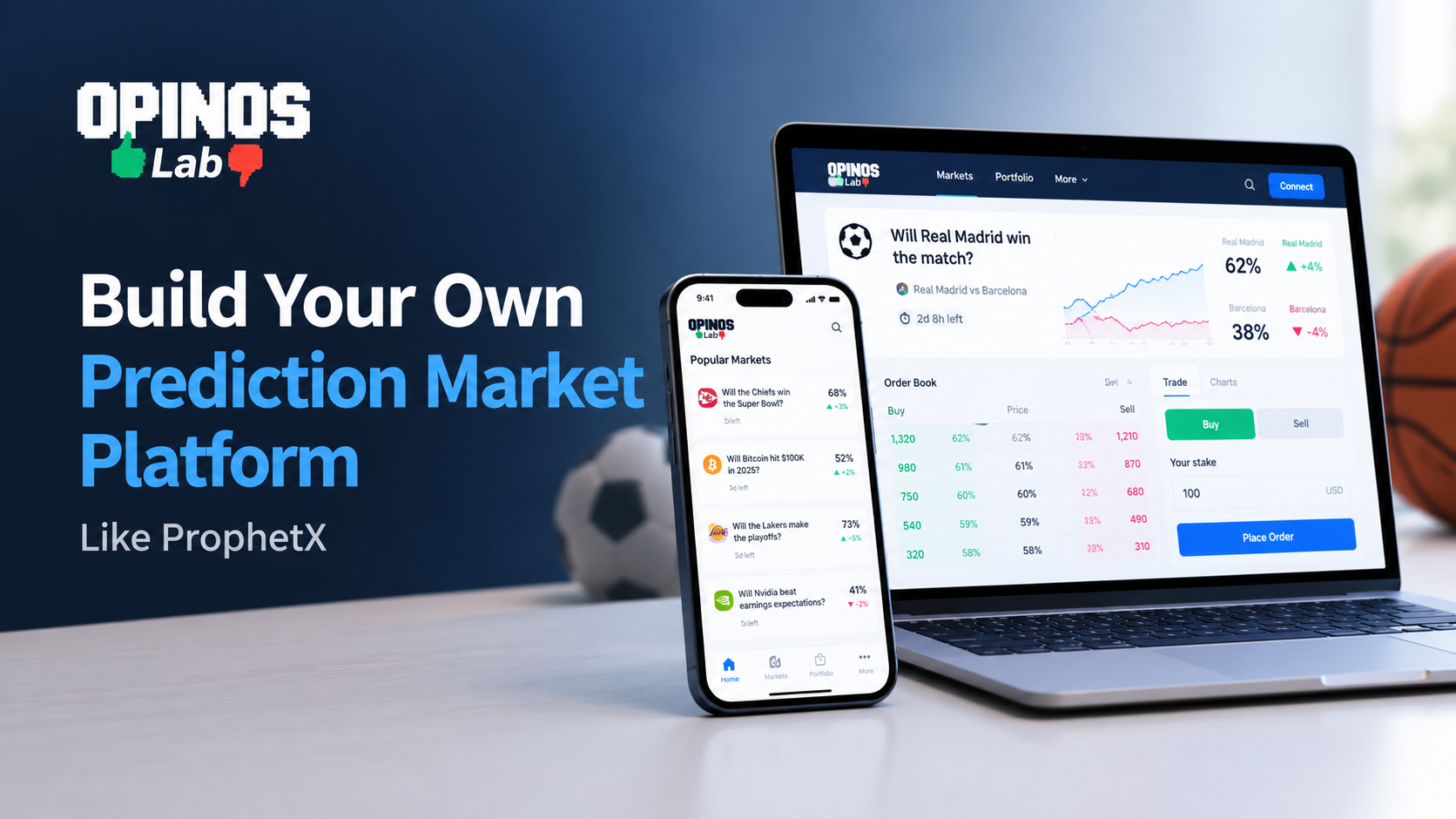
Imagine you open a sports app. You do not bet against a bookmaker. You trade against other fans, and you set your own price. That is the idea behind ProphetX, and you can develop your own prediction market platform like ProphetX faster than you think. Prediction markets are one of the fastest growing corners of fintech right now. Monthly trading volume already runs into the billions. So the real question is simple. Should you build this, and how soon can you launch? The short answer: yes. With a prediction market platform development company like Opinios Labs, you can go live in about 60 days. Let us walk through it together.
30th September 2026
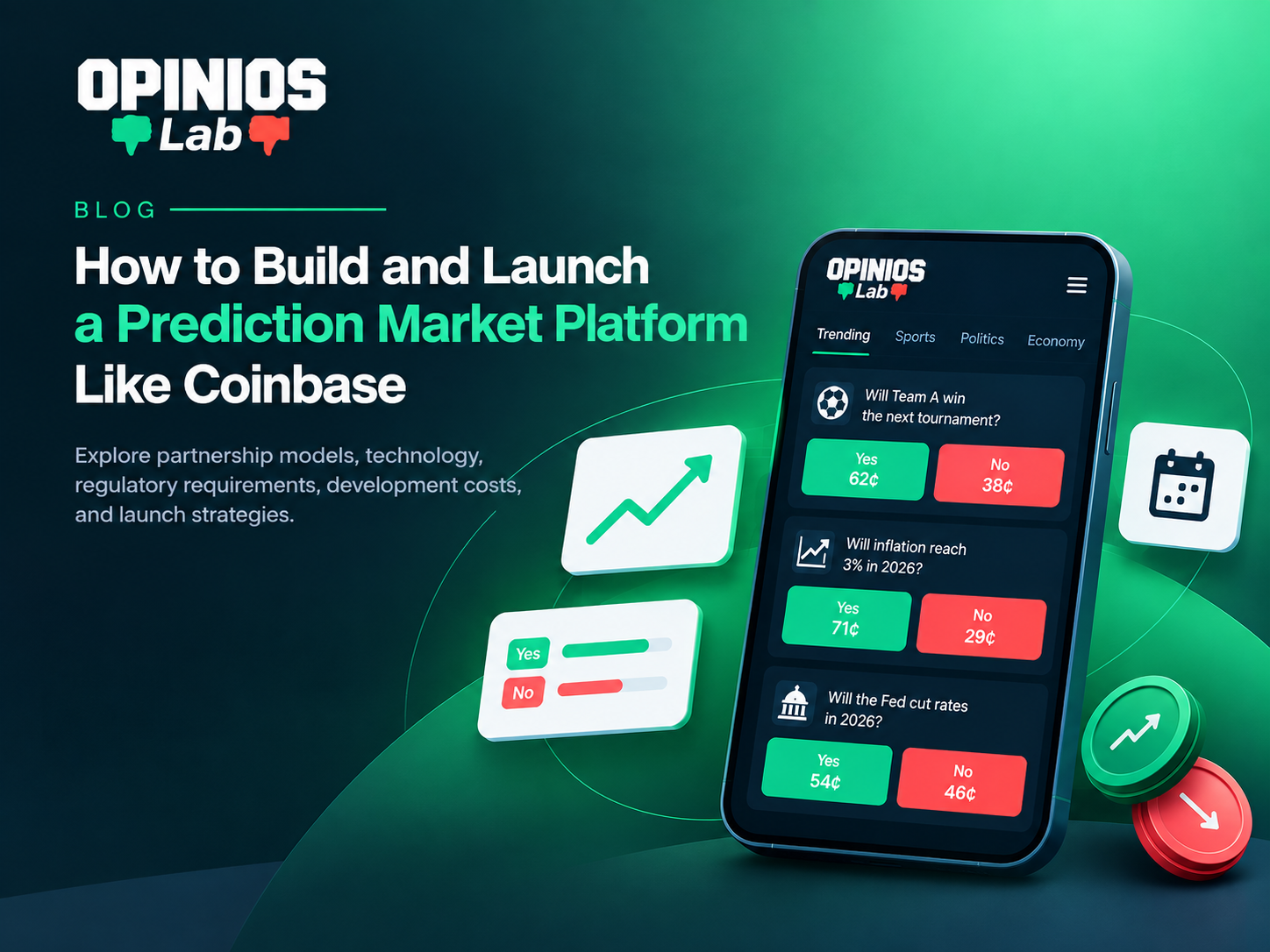
Imagine opening your favourite financial app and finding a new way to trade your opinions about the future. Instead of buying stocks or cryptocurrencies, you can predict whether a particular event will happen. Will a team win a major tournament? Will inflation reach a specific level? Will a particular economic event take place? This is the idea behind prediction markets, and the industry is growing rapidly. According to recent industry data, Kalshi and Polymarket recorded approximately $66.7 billion in combined volume during the first four months of 2026. Bernstein has also projected that the industry could reach around $240 billion in 2026 and approach $1 trillion by 2030. These figures should be independently verified before publication because the market is changing quickly. Coinbase's entry into prediction markets has attracted particular attention. Rather than building an entire prediction market exchange from the ground up, Coinbase launched its Predict offering through a partnership with Kalshi, a regulated prediction market operator. This approach raises an important question for entrepreneurs and fintech businesses. Should you build your own prediction market platform, or partner with an existing exchange? In this guide, we will explore how Coinbase approached the market, the technology behind prediction platforms, regulatory considerations, development costs, and the steps involved in launching your own solution. Whether you want to create a platform like Coinbase, build an independent prediction exchange, or introduce prediction features into an existing financial application, this guide will help you understand the process.
22nd September 2026
Frequently Asked Questions
Opinion trading can also be known as prediction trading where users trade on opinions based on future events. This is generally like betting like one can bet on knowledge & predictions. In opinion trading, users can buy and sell based on their predictions and it can be profitable if the predictions are correct.
For prediction marketplace platform development, it costs around $50,000 to $200,000+. The cost of the development may differ as per requirements like technology stack to be used, complexity, security of app, support after development etc.
Prediction market platform development is a great way to generate revenue based on transaction fees on trades. Different ways include selling data insights, advertisements, etc. Following is the structure that shows how revenue is generated with prediction market platform development.
Polymarket/Probo Clone is a custom-built platform that duplicates all the core functionalities of the popular decentralized prediction market called Polymarket. It enables people to create markets and participate in markets that predict real-world outcomes, for example elections, sports, or entertainment trends.
The time needed to develop a Polymarket/Probo Clone depends on the platform complexity and level of customizations: A simple version with all the necessary functions will take about 4-6 weeks, while a more complicated version with functions like multi-language support or blockchain integrations takes 8-12 weeks.
The price of a Probo Clone depends on features, complexity, and customizations; this is usually between $10,000 and $50,000. The simple versions would cost much less, while the advanced features like blockchain, real-time analytics, and support for multiple languages come at an extra cost. For the precise estimate, just be sure to detail your requirements with our development team.
As per the Online Gaming Bill, 2025 and applicable Indian laws, we strictly do not develop, provide, or promote any Real Money Games (RMG), Real Money Features, RMG Development Services, or Game with RMG Features. While our website may mention terms like “Real Money Game” or “RMG Features” for general informational and educational purpose.

